PTFE Seals Types, Applications, Design and Installation Considerations

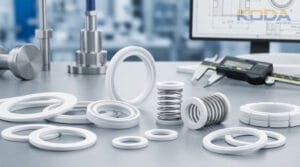
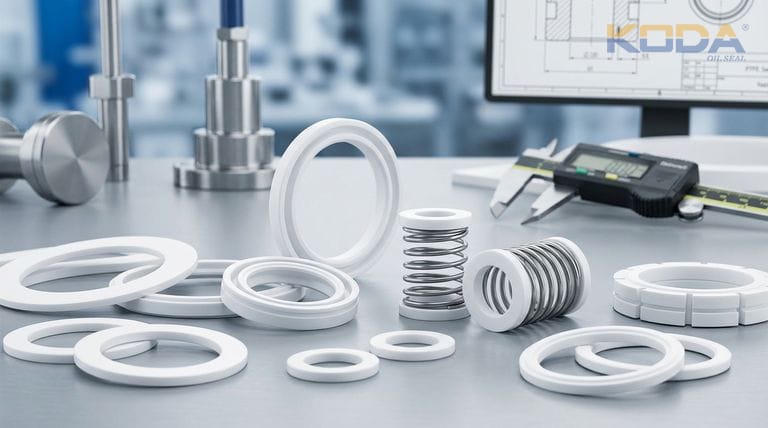
Polytetrafluoroethylene PTFE seals, also known as polytetrafluoroethylene seals, are indispensable components in industrial, automotive, aerospace, and medical applications, favored for their excellent chemical resistance, low coefficient of friction, and wide temperature tolerance range. Unlike traditional elastomer seals, PTFE seals perform exceptionally well in harsh environments where other materials fail, such as in systems ranging from cryogenic to high-pressure and in the presence of corrosive chemicals.
What Are PTFE Seals? Key Properties and Advantages
- Unmatched Chemical Inertness: PTFE Seals are resistant to nearly all industrial chemicals, solvents, acids, and bases—with the only exceptions being molten alkali metals and certain strong fluorinated compounds. This makes them indispensable in chemical processing, pharmaceutical, and semiconductor industries.
- Ultra-Low Friction: PTFE has one of the lowest friction coefficients of any solid material, comparable to wet ice on wet ice. This “self-lubricating” property minimizes wear on rotating or reciprocating shafts, reducing maintenance costs and extending equipment life.
- Non-Stick Surface: PTFE’s non-adhesive surface prevents fluids, debris, and contaminants from sticking to the seal, ensuring consistent performance and reducing buildup-related failures.
- Dimensional Stability: When properly filled and designed, PTFE Seals maintain their shape under pressure and temperature fluctuations, though pure PTFE is prone to creep (cold flow) and requires fillers to enhance mechanical strength.
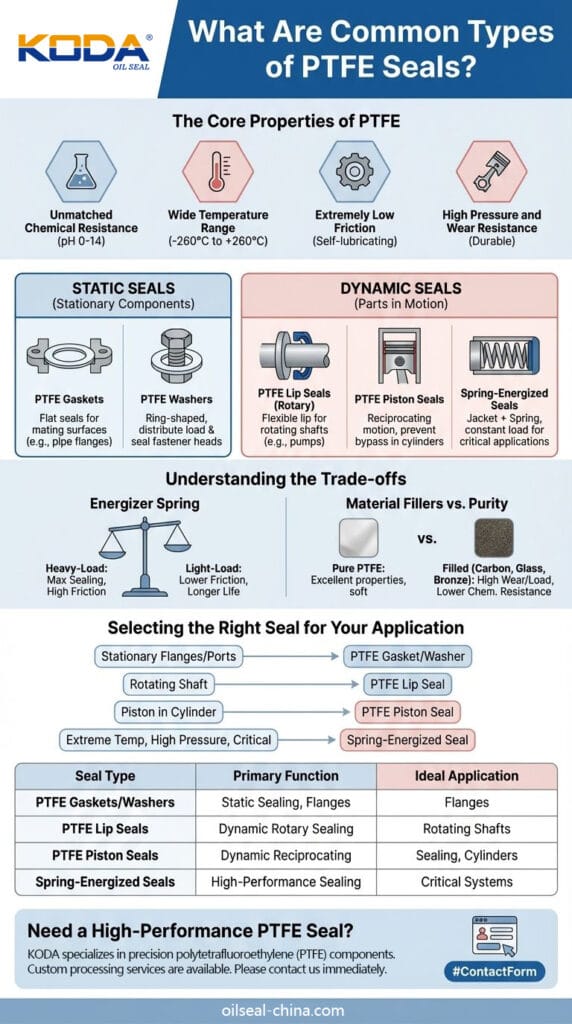
Common Types of PTFE Seals: How to Choose the Right One
1. Pure PTFE Seals
- Key Features: High chemical inertness, ultra-low friction, and wide temperature range. Limited wear resistance and prone to creep under sustained pressure.
- Ideal Applications: Static sealing in chemical processing, pharmaceutical equipment, and low-pressure systems where chemical compatibility is the top priority. Not recommended for high-pressure or dynamic applications due to creep risk.
2. Filled PTFE Seals
- Glass Fiber: Enhances mechanical strength, wear resistance, and dimensional stability. Ideal for high-pressure dynamic applications (e.g., hydraulic rods, piston seals).
- Carbon Graphite: Improves thermal conductivity, self-lubrication, and high-temperature resistance. Used in high-speed rotating applications and pneumatic systems.
- Bronze: Boosts wear resistance and load-bearing capacity. Widely used in hydraulic rod and piston seals for heavy machinery.
- Molybdenum Disulfide (MoS₂): Enhances lubrication for low-speed, high-load dynamic applications, reducing friction and wear.
3. Spring-Energized PTFE Seals
- Key Features: Reliable sealing at low pressures, cryogenic temperatures, and irregular surfaces. Compensates for PTFE’s lack of elasticity and creep. Available in single or double-lip designs for dust protection.
- Ideal Applications: Cryogenic systems (liquid nitrogen, liquid hydrogen), high-vacuum equipment, aerospace components, and dynamic applications with pressure fluctuations. Common in medical devices and semiconductor manufacturing.
4. PTFE O-Rings
- Key Features: Simple design, cost-effective, and compatible with standard O-ring grooves. Offers better chemical and temperature resistance than elastomer O-rings but requires careful groove design to prevent extrusion.
- Ideal Applications: Static and low-speed dynamic sealing in chemical processing, automotive engines, and industrial valves. Often used with backup rings in high-pressure applications to prevent extrusion.
5. PTFE Gaskets
- Key Features: Excellent chemical resistance, low compression set, and easy installation. Filled PTFE gaskets (e.g., glass-filled) resist creep and maintain seal integrity under high bolt loads.
- Ideal Applications: Flange connections in chemical plants, pharmaceutical equipment, food processing, and water treatment systems. Replaces elastomer gaskets in corrosive environments.
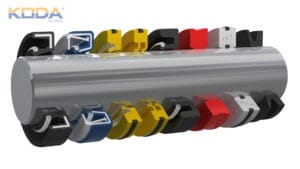
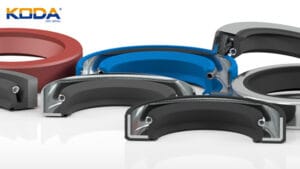
6. PTFE Lip Seals (Rotary Shaft Seals)
- Key Features: Low friction, high wear resistance, and compatibility with high shaft speeds. Resists chemicals and extreme temperatures better than elastomer lip seals.
- Ideal Applications: Pumps, compressors, mixers, gearboxes, and automotive wheel hubs. Used in harsh industrial environments where dust, chemicals, or high temperatures are present.
7. PTFE Backup Rings
- Key Features: High rigidity, wear resistance, and compatibility with high pressures. Prevents seal extrusion and extends seal life.
- Ideal Applications: High-pressure hydraulic and pneumatic systems, where PTFE Seals might otherwise extrude under pressure. Common in heavy machinery and aerospace systems.
PTFE Seals Applications: Industries and Use Cases
1. Automotive Industry
- Hydraulic and pneumatic systems (brake systems, power steering, transmissions).
- Engine components (camshaft seals, crankshaft seals, valve stem seals).
- EV batteries and cooling systems (resistant to coolants and electrical insulation requirements).
- Wheel hubs and drivetrain components (wear-resistant, low-friction PTFE lip seals).
2. Industrial Machinery
- Hydraulic and pneumatic cylinders (piston seals, rod seals, wiper seals—often filled PTFE or spring-energized).
- Pumps and compressors (rotary shaft seals, O-rings, gaskets—resistant to process fluids).
- Reducers and gearboxes (low-friction PTFE lip seals to prevent oil leakage).
- Robotic arms and automation equipment (precision PTFE Seals for smooth, low-wear movement).
3. Chemical Processing
- Flange connections (PTFE gaskets for acid, base, and solvent lines).
- Pumps and valves (spring-energized PTFE Seals and O-rings).
- Reactors and vessels (static PTFE Seals for high-temperature, high-pressure environments).
- Semiconductor manufacturing (cleanroom-grade PTFE Seals resistant to harsh etchants).
4. Aerospace and Defense
- Hydraulic systems (landing gear, flight controls—spring-energized PTFE Seals).
- Fuel systems (PTFE O-rings and gaskets resistant to jet fuel and high temperatures).
- Cryogenic systems (liquid oxygen, liquid hydrogen—spring-energized PTFE Seals for low-temperature sealing).
5. Medical and Pharmaceutical
- Medical devices (syringes, pumps, catheters—biocompatible PTFE Seals).
- Pharmaceutical equipment (mixers, reactors, filling machines—sterile PTFE gaskets and O-rings).
- Laboratory equipment (pipettes, centrifuges—chemical-resistant PTFE Seals).
6. Food and Beverage
- Food processing equipment (mixers, pumps, conveyors—FDA-grade PTFE Seals).
- Beverage lines (PTFE gaskets and O-rings resistant to acids and cleaning agents).
- Dairy equipment (sterile PTFE Seals for milk, cheese, and yogurt processing).
PTFE Seals Design Considerations: Key Factors to Ensure Performance
1. Material Selection (Pure vs. Filled PTFE)
- Pure PTFE: Choose for static applications where chemical compatibility is the top priority (e.g., chemical processing). Avoid for high-pressure or dynamic applications due to creep risk.
- Filled PTFE: Select for dynamic or high-pressure applications. Choose the filler based on your needs:
- Glass fiber: High pressure, wear resistance (hydraulic rods, pistons).
- Carbon graphite: High temperature, self-lubrication (rotating shafts, pneumatic systems).
- Bronze: Load-bearing, wear resistance (heavy machinery hydraulic seals).
2. Groove Design
- Groove Dimensions: The groove must be sized to fit the PTFE Seal with the correct compression (typically 5-10% for static seals, 3-7% for dynamic seals). Too much compression causes creep and premature wear; too little compression results in leakage.
- Groove Geometry: For dynamic seals (e.g., rod seals), use a rectangular groove with rounded edges to prevent damage to the PTFE lip. For high-pressure applications, include a backup ring groove to prevent extrusion.
- Surface Finish: The groove surface should be smooth (Ra ≤ 0.8 μm) to prevent abrasion of the PTFE Seal. Rough surfaces can cause leaks and premature wear.
3. Operating Conditions
- Pressure: For pressures above 10 MPa (1450 psi), use filled PTFE Seals with backup rings to prevent extrusion. Spring-energized PTFE Seals are ideal for low-pressure applications (below 1 MPa / 145 psi).
- Temperature: Ensure the PTFE material (pure or filled) can withstand the maximum and minimum operating temperatures. For temperatures above 260°C, consider specialized PTFE grades or alternate materials.
- Shaft Speed: PTFE Seals excel at high shaft speeds (up to 5 m/s for dynamic seals), but the shaft surface finish must be smooth (Ra ≤ 0.2-0.8 μm) to avoid wear. Use carbon-filled PTFE for high-speed applications.
- Fluid Compatibility: Verify that the PTFE material and filler are compatible with the fluid being sealed (e.g., fuels, oils, chemicals). While PTFE is highly inert, some fillers may react with specific fluids.
4. Static vs. Dynamic Sealing
- Static Sealing: Use pure or filled PTFE Seals with moderate compression. Spring-energized PTFE Seals are optional but can improve reliability in low-pressure static applications.
- Dynamic Sealing: Use filled PTFE Seals (glass, carbon, or bronze) for wear resistance. Spring-energized PTFE Seals are recommended for low-pressure dynamic applications or irregular surfaces. Ensure the PTFE lip is designed to minimize friction and wear.
PTFE Seals Installation Considerations: Best Practices to Avoid Failure
1. Pre-Installation Preparation
- Inspect the Seal: Check the PTFE Seal for defects (nicks, scratches, cracks, or delamination) before installation. Discard any damaged seals—even small defects can cause leaks.
- Clean the Sealing Surfaces: Ensure the shaft, housing, and groove are clean and free of debris, burrs, or rust. Even small particles can damage the PTFE lip or create leak paths. Use a lint-free cloth and compatible solvent to clean surfaces.
- Check Surface Finish: Verify that the shaft and groove surfaces meet the required finish (Ra ≤ 0.2-0.8 μm for dynamic seals, Ra ≤ 0.8 μm for static seals). Burrs or rough surfaces can abrade the PTFE Seal.
- Verify Compatibility: Confirm that the PTFE Seal material and filler are compatible with the fluid, temperature, and pressure of your application.
2. Installation Techniques
- Use Proper Tools: Use a soft, non-metallic installation tool (e.g., plastic or wooden mandrel) to avoid damaging the PTFE lip. Do not use metal tools, which can scratch or tear the seal.
- Lubricate the Seal: Apply a thin layer of compatible lubricant (e.g., oil, grease, or dry lubricant) to the PTFE lip and sealing surfaces before installation. This reduces friction during installation and prevents the seal from sticking to the shaft or housing. Ensure the lubricant is compatible with the fluid being sealed and the PTFE material.
- Align the Seal Properly: Ensure the PTFE Seal is aligned correctly with the groove. For dynamic seals (e.g., lip seals), the lip should face the fluid being sealed. Avoid twisting or stretching the seal during installation—PTFE has low elasticity and will not recover from permanent deformation.
- Apply Even Pressure: Press the PTFE Seal into the groove evenly, using a mandrel or press tool. Do not use excessive force, as this can cause creep or damage to the seal. For spring-energized PTFE Seals, ensure the spring is properly seated and not twisted.
3. Post-Installation Checks
- Visual Inspection: After installation, inspect the PTFE Seal to ensure it is seated correctly in the groove, with no twists, gaps, or damage. The seal should be flush with the housing surface (for static seals) or have a uniform lip contact with the shaft (for dynamic seals).
- Test for Leaks: Run the equipment at low pressure first, then gradually increase to operating pressure, checking for leaks. If leaks occur, shut down the equipment and inspect the seal for damage or misalignment.
- Monitor Performance: During initial operation, monitor the PTFE Seal for signs of wear, leakage, or overheating. Address any issues immediately to prevent further damage to the seal or equipment.
Common PTFE Seals Problems and Troubleshooting Tips
1. Leakage
2. Premature Wear
3. Extrusion
4. Creep (Cold Flow)
Conclusion
Polytetrafluoroethylene (PTFE) seals are versatile, high-performance components that solve sealing challenges in harsh environments where other materials cannot. By understanding the different types of PTFE seals, their applications, design principles, and best installation practices, you can select and implement reliable, low-maintenance, and long-lasting PTFE seals. Remember: the key to successful PTFE seals is selecting the appropriate seal type and material based on the specific requirements of your application—whether it’s high pressure, extreme temperatures, corrosive chemicals, or dynamic environments.
From chemically compatible pure PTFE seals to spring-loaded PTFE seals for cryogenic applications, each type is designed for a specific purpose. By following the design and installation guidelines outlined in this guide, you can avoid common mistakes and ensure your PTFE seals maintain optimal performance for years to come. If you are unsure which PTFE seal is right for your application, consult us for personalized advice based on your operating conditions.