Skip to content
Oil Seal Function Analysis and Maintenance Guide
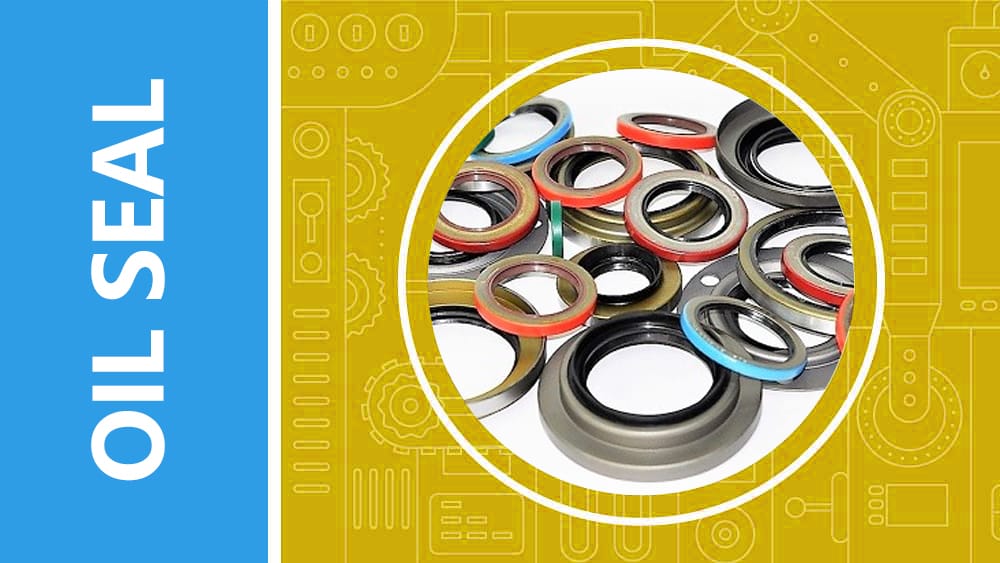
The function and core purpose of oil seals
Oil seal are among the most commonly used sealing elements in rotating or reciprocating motion mechanisms. Their main functions include
Preventing lubricant leakage: Preventing oil from leaking out of gearboxes, crankshafts, drive shafts, etc.
Blocking external contaminants from entering: Preventing dust, sediment, water, and metal shavings from entering the cavity, protecting bearings and other precision components.
Maintaining stable system pressure: Assisting in maintaining a certain internal pressure in some equipment, improving lubrication.
Extending equipment life: Significantly extending the service life of bearings and shafts by reducing wear and maintaining clean lubrication.
The sealing effect of an oil seal mainly depends on:
the tight fit between the oil seal lip and the shaft
the preload of the spring
suitable materials and structure
a good installation and operating environment
Introduction to oil seals
Oil seals (also known as shaft seals) are indispensable key components in various industrial equipment. Their main function is to prevent lubricating oil leakage and to block external dust, impurities, and contaminants from entering the system. Although oil seals may appear simple in appearance, their structural design, material selection, and adaptation to actual operating conditions involve complex technical considerations. This guide will help you gain a comprehensive understanding of the core functions, structural characteristics, common types, and key factors to consider when selecting oil seals for specific applications.
Oil seal structure
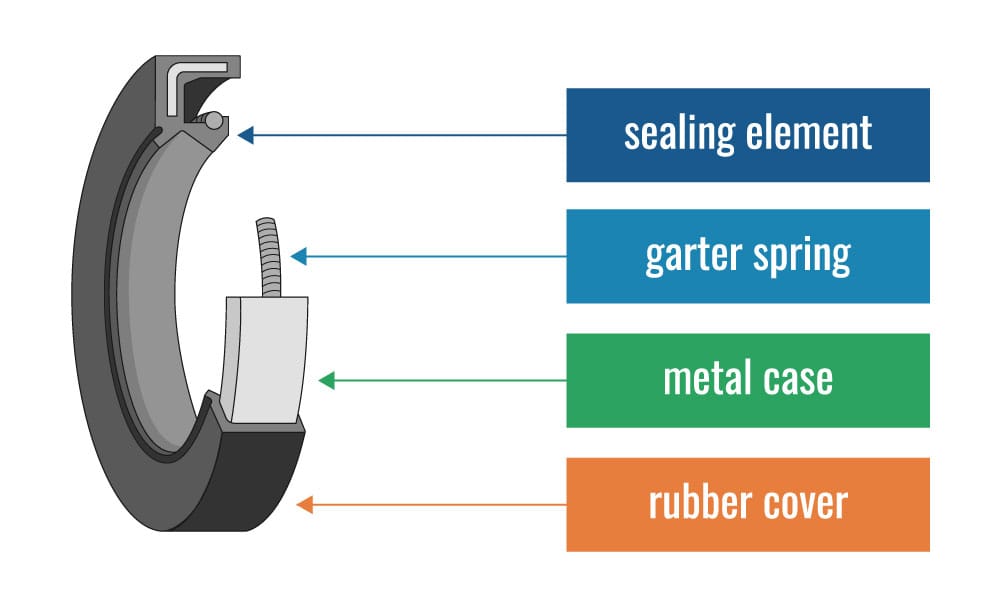
Oil seal body (rubber part): Provides the sealing lip; common materials include nitrile rubber (NBR), fluororubber (FKM/Viton), and silicone (SI).
Metal skeleton: Provides structural strength and facilitates installation.
Spring: Provides continuous lip preload, compensating for wear and eccentricity.
Secondary lip (dust lip): Used to block external dust, especially important in harsh environments.
Analysis of common failure modes and causes of oil seals
The following are the most common oil seal failure modes and their corresponding causes, which can be used for troubleshooting:
1. Oil leakage
Lip wear
Spring detachment or fatigue
Scratches or corrosion on the shaft surface
Eccentric installation or insufficient interference fit
2. Overheating, hardening, cracking
Oil temperature is too high
Material not heat-resistant (e.g., NBR used in environments above 120℃)
Incompatible oils (e.g., fluororubber in contact with strong oxidizers)
3. Lip edge turned up, twisted
Improper installation tools
Insufficient or no chamfering on the shaft
Deformation caused by tapping the oil seal during assembly
4. Dust entering causes abnormal wear
Dust is missing or damaged
High dust levels in the working environment
Poor ventilation leading to increased oil temperature
5 . The oil seal fell off completely
The interference fit is too small.
The machining accuracy of the housing bore is insufficient.
The oil seal size is mismatched.
Correct installation method for oil seals
To avoid 80% of oil seal failures, installation is the most critical step
1. Inspect the shaft and housing:
The shaft surface is free of scratches, burrs, and rust.
Housing bore dimensions and depth meet requirements.
Shaft chamfer 15°–30°, smooth with no sharp edges.
2. Select a suitable oil seal:
Material compatible with temperature and medium.
Dimensions (inner diameter, outer diameter, width) are accurate. Models with dustproof lips are preferred for outdoor or dusty environments.
3. Apply lubricant:
Apply a thin layer of lubricant or assembly grease to the lip and shaft surface.
Dry installation is prohibited.
4. Press in using a special tool:
Press in evenly, avoiding impact.
The oil seal must be perpendicular to the mounting surface.
5. Inspect the spring:
Ensure the spring is not detached or twisted.
The lip should fit evenly against the shaft surface.
Oil seal maintenance and care recommendations

Oil seals are wear parts, but proper maintenance can significantly extend their lifespan.
Regularly check oil level and quality: Prevent oil contamination or deterioration that can lead to lip hardening.
Maintain ventilation and heat dissipation: High temperatures are the number one killer of oil seal lifespan.
Inspect the shaft surface condition: Minor wear can be polished; severe wear requires shaft repair or replacement.
Avoid overload operation: Excessive vibration and high speed will accelerate oil seal wear.
Replace oil seals regularly: Even if there is no obvious damage, replacement is recommended during major overhaul cycles to prevent sudden leaks.
Oil Seal Material Selection Guide
NBR (Nitrile Butadiene Rubber): Suitable for mineral oils and gear oils, temperature range -30℃ to 120℃. Most commonly used.
FKM (fluororubber): Suitable for high temperatures, chemicals, and fuels; temperature range -20℃ to 200℃.
SI (Silicone Rubber): Suitable for extremely low and alternating high-temperature environments, temperature range -60℃ to 200℃, but with lower mechanical strength.
ACM (Acrylic Rubber): Suitable for high-temperature engine oils, temperature range -20℃ to 150℃.
Oil seals are indispensable key components in various mechanical equipment, playing an irreplaceable role in preventing lubricating oil leakage, blocking external contaminants, and ensuring stable and efficient equipment operation. A thorough understanding of oil seal design principles, material properties, and selection criteria can help you make more precise choices based on actual operating conditions. A suitable oil seal can not only significantly improve equipment reliability and service life but also optimize operating efficiency, bringing irreplaceable value to overall production.
KODA offers over ten thousand oil seal models and boasts a cross-reference part numbering system covering original equipment manufacturers (OEMs) and various other manufacturers. Simply enter the OEM or manufacturer’s part number to quickly find the corresponding KODA oil seal. If you don’t have the part number, you can also visit our product page and use the search function to find the required oil seal type. If you have any questions about oil seal selection for specific applications, please feel free to contact us; our sales and engineers will provide you with professional solutions.