
Zehn Fragen zur O-Ring Herstellung
Table of Contents
How are O-rings manufactured step by step?
O-rings are manufactured through a controlled elastomer processing chain that transforms raw rubber compounds into precision sealing rings. While details vary by material (NBR, FKM, EPDM, silicone), the overall process follows a consistent industrial workflow.
| Step | Description | Tools/Materials | importance |
|---|---|---|---|
| mixture | Mixing rubber types and additives | mixer | Basis for quality |
| Design | Press the mixture into a mold | Press molds | Determines size/shape |
| Vulcanization | Curing through heat/pressure | vulcanizing press | Ensures properties |
| Deburring | Remove excess material | Deburring tools | Improved surface |
| Quality inspection | Testing against standards | Measuring instruments | Guaranteed quality |
REQUEST O-RINGS QUICKLY AND EASILY?
⇒ Almost any dimension available
⇒ Offer received in record time
⇒ No minimum order quantities or minimum item values
⇒One contact for all concerns
How are additives in O-ring compounds defined?
Additives in O-ring compounds are carefully selected chemical ingredients added to the base rubber polymer to control performance such as strength, flexibility, chemical resistance, and durability. They are defined through a combination of formulation engineering, material standards, and application requirements.
| Additive | function | Example | importance |
|---|---|---|---|
| Fillers | Enhance the mixture | soot, chalk | Determines strength |
| Plasticizers | Increase flexibility | Phthalates | Affects elasticity |
| Anti-aging agents | Protection against weathering | Antioxidants | Extends lifespan |
| Vulcanization accelerator | Accelerates vulcanization | Sulfur compounds | Controls curing time |
| Color pigments | Dye the O-ring | Titanium dioxide (white) | For specific applications |
What are the names of the processes for manufacturing O-rings?
O-rings are manufactured using several standard rubber processing and molding methods. The names of these processes describe how the raw elastomer is shaped and cured into a finished sealing ring.
| Proceedings | When used | Advantage |
|---|---|---|
| Compression process | For simple to medium-complex O-ring geometries and small to medium production runs | Cost-effective for smaller production runs; good control over material filling and properties |
| Injection molding | For complex geometries and large production runs | High precision and reproducibility; efficient in mass production; minimizes material waste |
| Shock vulcanization | For large or specially shaped O-rings that cannot be manufactured as a continuous ring. | Enables the production of O-rings in virtually any size; flexible in the case of special shape requirements. |

How does the black color come about in O-rings?
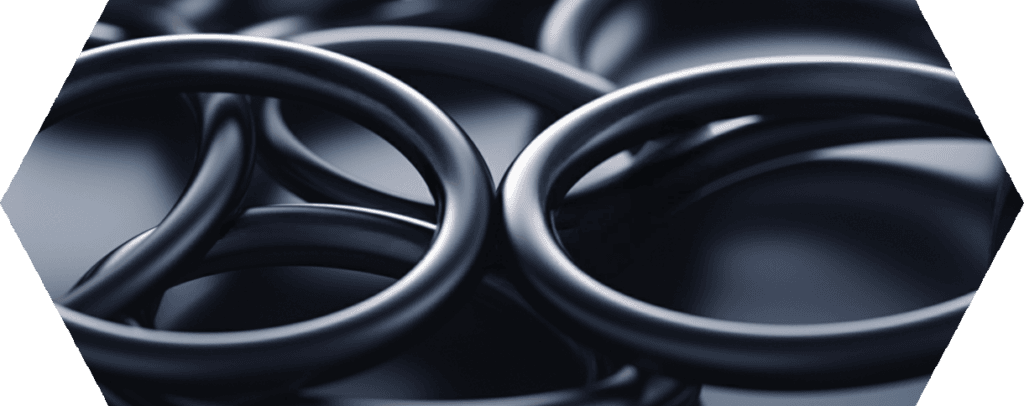
The black color in most O-rings is not just cosmetic—it is the result of a specific additive, usually carbon black, mixed into the rubber compound during manufacturing.
| Characteristic | Influence of soot | Advantage |
|---|---|---|
| Mechanical properties | improvement | Increased strength and durability |
| UV and ozone resistance | increase | Extended lifespan in harsh environments |
| Heat dissipation | improvement | Improved performance at high temperatures |
| Cost | Cost-efficient | Economically advantageous for production |
| Color | Uniform black color | Consistent appearance |
How does an O-ring meet the most important quality criteria?
An O-ring meets the most important quality criteria when it consistently performs its primary function—creating a reliable, long-lasting seal under defined operating conditions. Quality is not judged by appearance alone, but by a combination of dimensional accuracy, material performance, and functional testing.
| criterion | Description | Testing procedure |
|---|---|---|
| Dimensional accuracy | Compliance with specified dimensions | Gauges, micrometers |
| Material resistance | Resistance to media/temperatures | Chemical/Thermal Tests |
| hardness level | Determination of material hardness | Shore hardness test |
| Pressure and elongation properties | Behavior under load | Tensile and compression tests |
| Industry standards | Compliance with specific standards | ASTM, ISO certifications |
| Surface defects | Free from cracks and defects | Visual inspection |

How is deburring carried out on O-rings?
Deburring O-rings (often called deflashing) is the process of removing excess rubber—known as flash—that forms along the parting line of the mold after vulcanization. Since O-rings are precision sealing components, even tiny burrs can affect sealing performance, so the process must be controlled and consistent.
| method | Description | Advantages |
|---|---|---|
| Manual trimming | Removal of burrs with tools | Precise control |
| Cryogenic deburring | Use of cold for burr removal | Effective for hard materials |
| Drum deburring | Loops in a drum | Uniform surface |
How does an O-ring meet REACH and RoHS requirements?
An O-ring meets REACH and RoHS requirements when its material formulation, additives, and manufacturing process are controlled so that restricted or hazardous substances are either not used or kept below regulatory limits, and when this compliance is properly documented through the supply chain.
| Regulation | Restricted substances | Application |
|---|---|---|
| REACH | Specific chemicals | General Products |
| RoHS | Lead, mercury, cadmium, among others | electronics |
How do you test the durability and performance of O-rings?
Testing the durability and performance of O-rings means evaluating how well they maintain sealing ability under real operating stresses such as pressure, temperature, motion, and chemical exposure. In industry, this is done through a combination of standardized laboratory tests and application-simulating tests.
| Test type | Description | Purpose |
|---|---|---|
| Tensile strength | Measures the force until breakage | Assessment of mechanical strength |
| Hardness test | Determines the material hardness | Assessment of elasticity |
| Aging tests | Exposure to heat/ozone | Lifespan prediction |
| Media resistance | Contact with chemicals/liquids | Chemical resistance testing |
How do temperature and vulcanization time affect O-rings?
Temperature and vulcanization time are two of the most critical factors in O-ring manufacturing because they directly control the final molecular structure of the rubber, which determines strength, elasticity, compression set, and lifespan.
| factor | Influence | Optimal conditions |
|---|---|---|
| temperature | Accelerates vulcanization | Check carefully |
| vulcanization time | Determines the degree of hardening | Adhere precisely |
| Overhardening | Does it make the O-ring brittle? | Avoid |
| Underhardening | Impairs strength/elasticity | Avoid |

How do you recycle O-ring materials?
Recycling O-ring materials is possible, but it’s more complex than recycling thermoplastics, because most O-rings are made from vulcanized elastomers (cross-linked rubber). Once cured, they cannot simply be melted and reshaped. Instead, recycling focuses on mechanical, chemical, or energy recovery methods.
| method | Description | Advantages | Disadvantages |
|---|---|---|---|
| Mechanical recycling | Crush and grind into granules | Simple and cost-effective | Limited purity |
| Chemical recycling | Reduction into monomeric components | High purity possible | more technically complex |
| Energy recovery | Combustion for energy generation | Energy generation | Not sustainable |

Maggie(manager)
The King of Seals
KODA Seals Author