 Skip to content
What is a hardness tester?
What is a hardness tester (Shore hardness tester)?
The hardness of rubber materials is measured using a Shore A hardness tester; the higher the hardness value, the harder the rubber material.
When selecting O-rings, it is recommended to prioritize rubber materials with a Shore A hardness, as they provide the optimal solution for most applications, balancing sealing performance and durability.
Rubbers of different hardnesses exhibit significantly different properties: soft rubbers have better ductility and superior sealing fit on rough contact surfaces; hard rubbers possess stronger wear resistance and extrusion resistance.
Special attention must be paid to the extrusion risk of O-rings under high-pressure conditions. Refer to the accompanying charts on this page to accurately match the rubber material with the appropriate hardness based on fluid pressure and maximum extrusion gap.
Shore A hardness 60 is softer than 70,
70 Shore A is the standard hardness,
90 Shore A is very hard.
The hardness of an elastomer is determined by the indentation depth using an impact indenter of standard size and shape.
In specific measurements, the difference in indentation depth under an initial small load and a final large load is compared to calculate the hardness value.
The International Rubber Hardness Rating (IRHD) ranges from 0 to 100, corresponding to material properties with an elastic modulus of 0 (grade 0) and infinity (grade 100), respectively. The measurement principle involves pressing a rigid indenter into the rubber sample and calculating the hardness value based on the indentation depth.
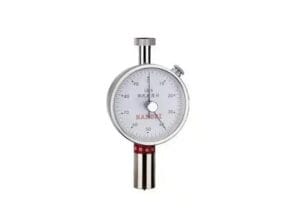
Overview
The Shore A hardness scale is the most widely used hardness measurement standard in the United States, with a reading range of 30–95 degrees. For elastomers with higher hardness, the Shore D hardness scale, used in conjunction with a pointed conical indenter, must be used for testing.
Within a range of similar elastomer resilience, the Shore A hardness and the International Rubber Hardness Rating (IRHD) test results are generally consistent. However, for elastomers with abnormally high stress relaxation rates or deformation hysteresis, the two scales may deviate due to differences in test dwell times. Furthermore, all hardness test results are affected by the thickness of the elastomer sample; samples with the standard-specified thickness must be used during testing.
Due to limitations in the mechanical properties of the testing instruments, the accuracy error of elastomer hardness measurement is usually not less than 5 hardness units.
It should be noted that surface indentation hardness is not directly related to the actual working performance of elastomer components. Hardness reflects the elastomer’s ability to resist small surface stresses, while stiffness and compressive modulus are the core indicators for measuring the mechanical response of elastomer components under large stresses.
Reference Standards:
- ISO 48 (IRHD Hardness Test)
- ISO 7619 (Shore A Hardness Test)
- ASTM D1415 (IRHD Hardness Test), D2240 (Shore Hardness Test)
The hardness tester scale is the key basis for determining the hardness of rubber materials. The rubber hardness comparison table below can help with selection. The hardness of most rubber materials falls within the Shore A scale range. For example, if you need to choose a rubber material with a hardness close to that of running shoe soles or regular O-rings, it is recommended to prioritize Shore 70A—this hardness is currently the most widely used general-purpose rubber hardness in the industrial field.
Shore A hardness tester (hardness) chart
The following values provide a visual comparison and understanding of the performance differences of different elastomers under the Shore A hardness standard:
- 25 degrees: Hardness comparable to a rubber band
- 55 degrees: Hardness close to that of a rubber inner tube
- 70 degrees (most widely used): Hardness equivalent to that of a rubber tire or rubber shoe heel
- 95 degrees: Hardness consistent with that of a shopping cart wheel
KODA provides equipment to test the hardness or Shore hardness of oil seals and O-rings.