 Skip to content
O-ring pressure rating
What is the maximum pressure that O-rings of different sizes can withstand?
Most resilient seals are designed for a working pressure of approximately 1500 PSI. Under high-pressure conditions, it is crucial to prevent the seal from being squeezed out of the gap and failing. The actual pressure resistance of an O-ring depends primarily on the following key factors:
- Gap (Extrusion Gap)
- O-ring Hardness Value
- Support Ring Configuration
- Static/Dynamic Application
- Scenarios
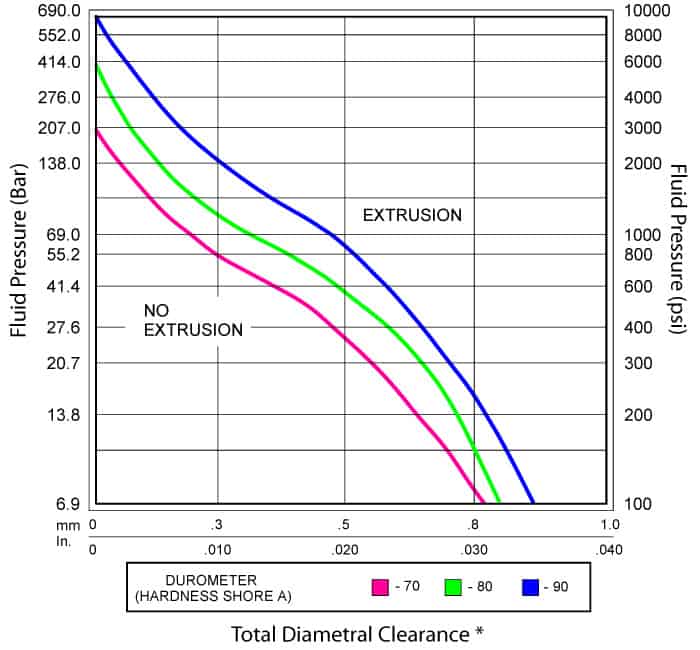
The chart at the bottom of this page visually illustrates the relationship between fluid pressure, clearance, and hardness.
Technical solutions to prevent O-ring extrusion in high-pressure applications mainly include reducing the installation gap, selecting O-rings with higher hardness, and adding support rings.
Gap (compression gap)
Generally speaking, the smaller the installation gap, the higher the pressure the O-ring can withstand before it deforms due to compression; conversely, the larger the gap, the greater the probability of the O-ring deforming due to compression. The combined effect of high pressure and large gap is the most unfavorable condition that makes it difficult for the O-ring to maintain its original shape and sealing function.
For more professional parameters on O-ring groove design, please click here.
O-ring hardness
High-hardness O-rings are better suited for high-pressure applications and possess superior resistance to compression. O-rings made from these rigid materials require greater pressure to deform under compression. It’s important to note that high-hardness O-rings have relatively lower compression resilience, which is their main limitation.
Spare ring
Adding support rings significantly improves the O-ring’s resistance to compression while minimizing installation gaps, achieving a near-zero gap seal.
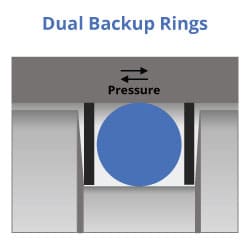
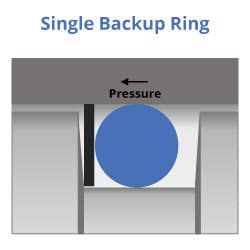
The configuration of the support rings needs to be determined based on the pressure direction: if the high pressure comes from only one direction, only one support ring needs to be added to the low-pressure side of the seal; if the high pressure comes from both directions, it is recommended to add one support ring to each side of the O-ring.
Common materials for support rings include nitrile rubber (NBR), fluororubber (FKM), polytetrafluoroethylene (PTFE), polyetheretherketone (PEEK), and nylon.
Static applications and dynamic applications
Compared to dynamic applications, O-rings can withstand a higher pressure limit in static applications.
In dynamic applications, if the friction direction between the moving metal surface and the O-ring is the same as the pressure direction, the O-ring is at risk of being dragged into the gap. The pressure value causing this problem may be less than half of the typical extrusion failure pressure.
For more professional information on O-rings and support rings under high-pressure conditions, please call +8618730921709 or submit a contact form with your specific specifications.