Skip to content
O-ring color coding system, labeling specifications and batch management
Summary
Many customers encounter key pain points in the selection, use, storage, and after-sales traceability of O-rings, including the inability to distinguish specifications and materials among O-rings with the same appearance; misuse due to confusing labels and inability to trace batches when quality problems occur. These issues not only affect production efficiency but may also lead to safety hazards such as equipment leaks and malfunctions due to the misuse of substandard products. This article will start from the actual needs of customers and break down the core contents of O-ring color coding systems, label specifications, and batch management in detail to help you quickly solve identification and traceability problems, achieve standardized management of O-rings, and reduce usage risks.
O-ring color coding system: solves the core pain point of inability to distinguish and use the wrong model
For customers, facing a pile of O-rings that look similar but differ only in specifications or materials, it is difficult to quickly distinguish them with the naked eye, especially during emergency parts changes on the production line or bulk inventory checks in the warehouse. This can easily lead to mistakes in selection and use, wasting time and potentially damaging equipment. The core function of an O-ring color coding system is to provide a unified standard of color corresponding to specification/material, allowing operators to identify key information at a glance without the need for specialized tools, thus preventing misuse from the outset.
It is important to clarify that the color of an O-ring itself does not determine its sealing performance, temperature and pressure resistance, or other core indicators (performance is determined by material and size). The color serves only as a visual identifier for easy and quick differentiation. Currently, there are universal color coding standards in the industry (different manufacturers can make minor adjustments based on this standard, but this needs to be synchronized with customers in advance). The core logic is as follows, tailored to actual customer usage scenarios, and easy to remember and use:
1. By material code (most commonly used, to solve the potential problem of using the wrong material)
One of the most common pitfalls for customers is misusing ordinary nitrile rubber (NBR) O-rings in oily, high-temperature, or corrosion-resistant environments, leading to rapid aging and leakage of the O-rings. Distinguishing materials by color directly avoids this problem:
- Black: Nitrile Butadiene Rubber (NBR) – The most common material, suitable for ordinary oil and water media, and normal temperature scenarios (such as seals for general mechanical equipment). Customers can easily identify it, and it meets most common needs.
- Brown: Fluororubber (FKM) – High temperature and corrosion resistant, suitable for high-temperature oil and acid/alkali media (such as engines and chemical equipment). Its color is highly recognizable, avoiding confusion with ordinary black O-rings.
- Transparent/Milk White: Silicone Rubber (MVQ) – High and low temperature resistant, non-toxic, suitable for the food, medical, and electronics industries (such as food machinery seals and appliance seals). It is easily distinguishable from the commonly used black and brown O-rings in industry.
- Blue: Hydrogenated Nitrile Butadiene Rubber (HNBR) – Oil-resistant and aging resistant, suitable for high-pressure and high-temperature scenarios (such as hydraulic systems). It differs from the black of ordinary nitrile butadiene rubber, facilitating specific identification in high-pressure scenarios.
- Green: Ethylene Propylene Diene Monomer (EPDM) – Water-resistant and ozone-resistant, suitable for outdoor use, bathrooms, and refrigeration systems. Avoid confusion with fluororubber and nitrile rubber. Suitable for humid environments.
2. Code according to specifications (to help distinguish and solve the size mismatch problem)
When the materials are the same, but the inner diameter (ID) or wire diameter (CS) differs, they can be distinguished by a combination of color + color stripe (different manufacturers have standardized specifications, which will be communicated to customers in advance):
Solid color: Basic specifications (standard inner diameter, wire diameter, such as the standard models commonly used by customers);
Single color stripe: Non-standard small specifications (inner diameter < 5mm, wire diameter < 1mm);
Two color stripes: Non-standard large specifications (inner diameter > 50mm, wire diameter > 5mm);
Three color stripes: Special specifications (such as irregular O-rings, custom sizes), allowing customers to quickly select custom models.
3. Customer usage reminders
1. If customers use O-rings made of multiple materials, it is recommended to post an O-ring Color-Material Correspondence Table in the warehouse and production line. Operators will not need to memorize it and can directly refer to the table.
2. For custom-made O-rings, the manufacturer will additionally mark the color with a unique code. Customers need to keep a copy of the code correspondence table to avoid confusion when changing parts later.
3. Avoid relying on color to judge performance: If the material corresponding to a color is uncertain, it needs to be confirmed by referring to the label information. Color is only used as a quick identification aid; the core performance is based on the label.
O-ring Labeling Standards: Clear labeling to solve the problems of ambiguous information and the inability to verify.
Many customers have reported that upon receiving O-rings, the labels are often blurry, incomplete, or fail to provide accurate information such as material, specifications, and shelf life. In some cases, the labels even detach after a period of storage, rendering the entire batch of products unusable. The core of standardized labeling is to provide a one-stop shop for all key information, allowing customers to quickly access the necessary details during receipt, storage, use, and verification, while also facilitating future traceability.
1. The label must include 6 core pieces of information (all are required and must meet the client's verification needs)
Whether packaged individually or in cartons, O-rings must be clearly labeled with the following information to avoid verification difficulties due to missing information:
Product Name: Clearly label O-ring to avoid confusion with other sealing components (such as gaskets, sealing rings, etc.);
Specifications: Detailed labeling of inner diameter (ID), wire diameter (CS), and outer diameter (OD, optional), all in mm (e.g., ID10×CS2.4). Customers can directly check against drawings to avoid dimensional discrepancies.
Material Information: Label the full material name plus abbreviation (e.g., Nitrile Butadiene Rubber NBR), cross-checking with color coding to ensure correct material.
Standards: Label industry standards or company standards (e.g., GB/T). (3452.1-2005) Customers can compare the product to the standard to determine if it meets their usage requirements.
Batch Number: Core traceability information, uniformly compiled by the manufacturer (e.g., 2026020601), including production date and batch number, which customers should keep carefully.
Shelf Life + Storage Conditions: Indicates shelf life (e.g., 12 months) and storage requirements (e.g., cool, dry place, avoid direct sunlight, keep away from oil) to help customers store the product properly and prevent it from aging and becoming ineffective.
2. Supplement to labeling specifications (tailored to actual customer usage scenarios)
Label Material: Waterproof, oil-proof, and wear-resistant materials (such as laminated paper and PVC) are used to prevent the text from becoming blurry and the labels from falling off during storage and use (solving the customer pain point of easily damaged labels).
Labeling Location: Individual O-ring labels are affixed to the center of the front of the packaging, while labels for the entire carton are affixed to the side of the carton (in a prominent position) for easy customer viewing without the need to open the package for verification.
Text Requirements: Clear and wear-resistant printed fonts are used, with a moderate font size (avoiding fonts that are too small to be easily seen), and the color has a clear contrast with the label background (e.g., black font + white label), ensuring clear legibility even after aging.
Additional Labeling for Customized Products: If O-rings are customized for customers (e.g., special size, special material), they must be additionally labeled Customized + customer customization number to help customers distinguish them from regular products and facilitate subsequent communication with the manufacturer.

O-ring batch management: full traceability, solving the pain points of inability to locate quality problems and difficulty in assigning responsibility
If customers encounter quality issues such as leakage or premature aging while using O-rings, their core need is to quickly locate the source and batch of the problematic products, determine whether it is a batch issue or an individual problem, and trace the entire process of production, inspection, and shipment to prevent the problem from escalating and minimize losses. The core of batch management is to assign a unique ID card(batch number) to each batch of O-rings, achieving full traceability from production to use, thus protecting customer rights and facilitating rapid resolution of quality issues.
1. Batch numbering system (customers can quickly understand and easily trace the batches).
Batch numbers don’t need to be complex; the core is that they contain key traceability information, allowing customers to quickly interpret the production date and batch number. A general coding rule is recommended (manufacturers can standardize this, and customers can retain their own rules):
Example: 2026020601 (10 digits, easy to understand and remember)
First 8 digits: Production date (20260206 = February 6, 2026). Customers can quickly determine the product production time and, combined with the shelf life, determine if it expired.
Last 2 digits: Production batch number for that day (01 = first batch of that day, 02 = second batch of that day), facilitating the identification of the specific production time and production line.
Supplement: If customers have special traceability requirements, production line number and inspector numbercan be added to the batch number (e.g., 2026020601A01, A = production line A, 01 = inspector 01) to further improve traceability accuracy.
2. Hands-on practice of batch management on the client side (simple and easy to implement, no extra workload required)
Batch management is not only the manufacturer’s responsibility; close cooperation from the client is essential for achieving full traceability and resolving practical problems. The core operational steps are as follows:
- Receiving Verification: Upon receiving O-rings, verify that the batch number on the label matches the batch number on the delivery note to ensure delivery note correspondence and avoid incorrect or missing batches.
- Storage Management: Store O-rings by batch, grouping them and affixing batch labels to prevent mixing of different batches (solving the pain point of batch confusion and lack of traceability). Store according to the storage conditions indicated on the labels and conduct regular checks to prevent batch expiration.
- Usage Records: When using O-rings on the production line, briefly record batch used, quantity used, date used, and equipment used(this can be simply recorded in a ledger). If a quality problem occurs, it allows for quick identification of which batch and which equipmentwas used.
- After-Sales Traceability: If a quality problem is found in a batch of O-rings, immediately stop using that batch. Retain the remaining products and packaging labels, and provide the batch number to the manufacturer. The manufacturer can quickly trace the production and inspection records of that batch to determine the cause of the problem. Simultaneously, the customer can use the usage records to investigate the usage of other products in the same batch, preventing the problem from escalating.
3. The core value of batch management (aligning with customer needs)
- Quality Traceability: Issues can be quickly traced back to the batch, distinguishing between batch quality problems and individual product issues, facilitating rapid manufacturer intervention (such as returns, exchanges, and rectification) and minimizing customer losses.
- Inventory Management: Inventory is managed by batch and shelf life, prioritizing batches nearing their expiration date to avoid product waste (addressing customer pain points of stockpiling and expired products).
- Clear Responsibility: Full traceability of production, inspection, shipping, and usage stages allows for rapid allocation of responsibility in case of quality issues, protecting customer rights.
- Compliance Adaptation: For industries with strict compliance requirements, such as chemicals, medical, and food, batch traceability is essential. Standardized batch management helps customers meet industry compliance standards.
Frequently Asked Questions: Identification and Traceability of O-rings
How can you quickly identify the material of an O-ring by its color?
We adopt an industry-standard color coding system, with different colors corresponding to different materials (such as NBR, FKM, EPDM, HNBR, etc.), which makes it easy to quickly identify the material type without unpacking or testing, and avoids mixing materials.
What information does the marking on the O-ring contain?
Standard markings typically include: material code, hardness, dimensions, batch number, production year/week, and some products may also include standard number (such as AS568) and material certification information.
What production information can be traced back to by the batch number?
The batch number allows for traceability of raw material batches, mixing dates, molding machines, production times, inspection records, and shipping records, enabling full traceability from raw materials to finished products.
Why do O-rings require batch management?
Batch management ensures consistent quality, facilitates problem tracing, recall management, and quality statistical analysis, and meets the compliance and audit requirements of industries such as automotive, hydraulics, medical, and oil and gas.
How can we ensure that O-rings remain traceable after long-term use?
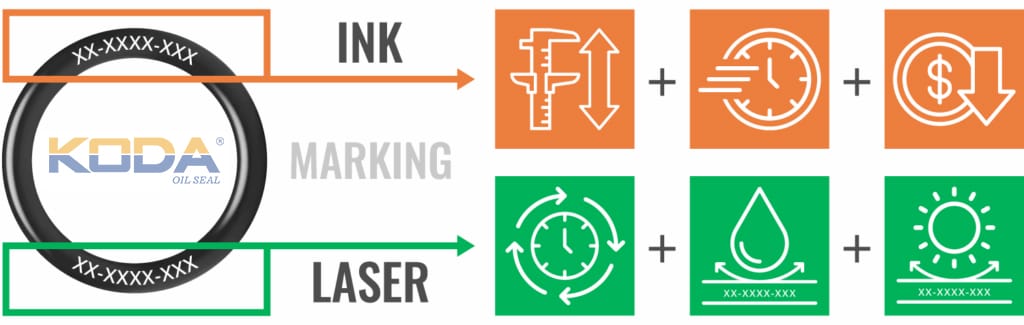
We use oil-resistant, temperature-resistant, and wear-resistant laser marking or molding to ensure that the markings remain clearly legible even under harsh working conditions, supporting full lifecycle traceability.