 Skip to content
O-ring AS568 size chart
O-ring AS568 Size Chart
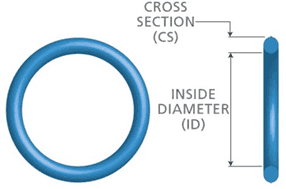
The AS568 standard (also known as the SAE Aerospace Standard) is the most widely used O-ring size designation system in the United States and many international markets. Instead of using complex dimensioning, this system employs simple three-digit hyphenated numbers (e.g., -001, -214) to represent specific combinations of inner diameter (ID) and cross section (CS).
Please use the comprehensive chart below to find the precise dimensions, tolerances, and hyphenated numbers for thousands of standard O-ring sizes.
O-ring AS568 Size Reference Table
If you would like to learn about the AS568 reference guide for O-rings, we will send it to you via email!
The history of AS568 O-rings
AS568 is an aerospace O-ring size standard published by SAE. It was first released in 1971 and has undergone multiple revisions to become a globally accepted O-ring size specification. Its core is to unify the inner diameter, cross-section, tolerances and marking system.
The history of AS568 O-rings
Many customers, upon receiving AS568 standard O-rings, find slight discrepancies between the caliper measurements and the “nominal size” in the standard specification. This is normal.
Simply put: “nominal size” is its name, and “actual size” is its dimensions.
Nominal size: This is the “code” we use to refer to it (e.g., -214), a universally accepted standard for easy ordering.
Actual size: This is the actual size of the rubber after cooling and shrinkage during high-temperature molding in the mold.
Especially the inner diameter, because rubber shrinks, the actual measurement is usually slightly smaller than the nominal value. As long as the actual size is within the tolerance specified in the AS568 standard, it is a qualified product and will not affect its use or sealing performance.
O-ring core calculation formula
Mastering the following two formulas allows you to easily convert between the inner and outer diameters of O-rings:
Outer Diameter (OD):
Formula: Inner Diameter + (2 × Wire Diameter) = Outer Diameter
Explanation: Start with the inner diameter and add twice the cross-sectional thickness.
Inner Diameter (ID):
Formula: Outer Diameter – (2 × Wire Diameter) = Inner Diameter
Explanation: Start with the outer diameter and subtract twice the cross-sectional thickness.