 Skip to content
Nitrile rubber O-rings
Material properties of nitrile rubber O-rings
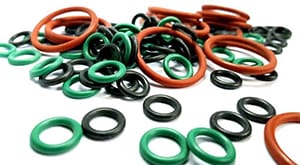
Nitrile-butadiene rubber (NBR) O-rings, also known as Buna-N O-rings, are among the most commonly used sealing materials due to their resistance to petroleum-based fuels and lubricants and their relatively affordable price. Nitrile elastomers are actually products of the polymerization of acrylonitrile and butadiene.
NBR has many common variant formulations. There are also metal-detectable NBR O-rings, which have the same performance as the standard versions.
If your application requires easily visible O-rings, it is recommended to choose high-visibility NBR O-rings. These O-rings not only have the same performance as the standard versions but also feature a striking fluorescent green color, making them highly identifiable.
Acrylonitrile Content
The acrylonitrile (ACN) content in the nitrile butadiene rubber (NBR) polymer molecular chain ranges from 18% to 50%, and its proportion directly affects the core properties of the material:
Low ACN content formulations: impart superior low-temperature resistance, but exhibit weaker resistance to petroleum-based fuels and polar lubricants.
High ACN content formulations: lead to a decrease in low-temperature performance, while significantly improving resistance to fuels and polar lubricants.
The acrylonitrile content of standard NBR is typically set at 34%.
Curing Systems: Sulfur Curing and Peroxide Curing
Standard nitrile butadiene rubber (NBR) O-rings are typically produced using a sulfur vulcanization process. Sulfur-vulcanized formulations offer superior low-temperature performance, but are prone to hardening at high temperatures.
Peroxide-vulcanized nitrile butadiene rubber O-rings exhibit better heat resistance and lower compression set; however, this process is more expensive and more difficult to manufacture.
Standard stock materials include two categories: sulfur-vulcanized series (hardness 70, 90, models N70, N90); and peroxide-vulcanized series (hardness 90, model N90PC).
Butyronitrile compounds
| Compounds | Durometer | Color | Temp Range (F) | Description |
|---|---|---|---|---|
| N90-B103 | 90 | Black | -40 to +257 | Peroxide-Cured |
| N90-C901 | 90 | Green | -4 to +248 | High visibility |
| N90-B102 | 90 | Black | -65 to +300 | Low Temperature |
| N90-A101 | 90 | Black | -13 to +250 | General purpose |
| N80-B102 | 80 | Black | -40 to +212 | UL 157 |
| N75-F701 | 75 | Green | -40 to +212 | Metal/X-ray detectable, FDA-Grade |
| N70-B502 | 70 | White | -40 to +212 | General purpose, FDA-Grade |
| N70-B701 | 70 | Green | -40 to +212 | General Purpose |
| N70-C401 | 70 | Blue | -40 to +212 | Metal/X-ray detectable, FDA-Grade |
| N70-B102 | 70 | Black | -35 to +250 | General purpose |
| N70-C102 | 70 | Black | -40 to +221 | General purpose, low temp resistance |
| N70-B106 | 70 | Black | -40 to +212 | NSF 61, FDA |
| N70-B103 | 70 | Black | -40 to +212 | UL 157 |
| N70-A101 | 70 | Black | -22 to +250 | General purpose |
| N50-B102 | 50 | Black | -40 to +212 | UL 157 |
| N50-B101 | 50 | Black | -40 to +212 | General purpose |
Preferred application environment for nitrile rubber O-rings
Performs Well In:
- Petroleum-based oils and fuels
- Aliphatic hydrocarbons
- Vegetable oils
- Silicone oils and greases
- Ethylene glycol
- Dilute acids
- Water up to 100ºC (212ºF)
Doesn't Perform Well In:
- Aromatic hydrocarbons
- Automotive brake fluid
- Chlorinated hydrocarbons
- Ketones
- Ethers
- Esters
- Phosphate ester hydraulic fluids
- Strong acids
- Ozone, weathering, and sunlight