Skip to content
Improve O-ring lifespan and structural integrity

Summary
As the most commonly used and cost-effective sealing component in the industrial sealing field, O-rings are widely used across equipment such as hydraulics, pneumatics, chemicals, automobiles, aerospace, and more, due to their simple structure, ease of installation, and reliable sealing.
Their service life and integrity directly determine the sealing performance and operational stability of equipment and even affect the safety and maintenance costs of the entire system.
Introduction
In industrial applications, the reliability and operational efficiency of mechanical equipment and systems largely depend on the integrity of their core components. Seals and O-rings, as critical components, ensure stable equipment operation, prevent media leakage, and maintain system pressure. A thorough understanding of the factors affecting the lifespan and durability of seals and O-rings helps extend their service life, optimize sealing performance, and ensure the safety and reliability of the entire system.
Accurate selection: Laying the foundation for long-term use of O-rings
Improper selection is a major cause of premature O-ring failure and shortened service life. Most customers mistakenly believe that universal O-rings are suitable for all working conditions, neglecting the compatibility between the working conditions and the O-ring’s material and size. Professional selection should focus on working condition matching and pay particular attention to the following three key dimensions to completely solve the problem of customers choosing the wrong type.
1. Material Selection: Matching Medium, Temperature, and Pressure Conditions
The material of O-rings directly determines their media resistance, temperature resistance, and pressure resistance. Different materials have significant performance differences, which need to be accurately matched according to specific working conditions to avoid corrosion, aging, cracking,g and other problems caused ba y mismatch between materials and working conditions. Combined with common industrial scenarios, the key points of core material selection and answers to common customer questions are as follows:
1. Nitrile Butadiene Rubber (NBR): It has excellent oil resistance and is a “cost-effective choice” for oil medium scenarios such as industrial hydraulics and automotive gearboxes. Its temperature resistance range is -40℃~120℃ (up to 150℃ with special formulas). The higher the acrylonitrile content, the stronger the oil resistance, but the low-temperature elasticity will decrease slightly. To answer customers’ questions of “What material is the most economical for oil medium scenarios?”, NBR can meet the needs of most mineral oil and hydraulic oil scenarios with controllable costs, but it should be avoided in polar solvent environments such as ethanol and acetone.
2. Fluorocarbon Rubber (FKM/VITON®): It is the “leader” in high-temperature and strong corrosion environments. It can withstand strong acids, alkalis, fuel oil,l and most chemicals, with a temperature resistance range of -20℃~200℃ (up to 250℃ with special formulas). The compression set rate after 200℃×70h is ≤25%, which is suitable for harsh working conditions such as aero-engines and chemical pipelines. To solve customers’ question of “how to deal with O-ring aging in high-temperature and corrosive scenarios”, fluorocarbon rubber should be preferred, and attention should be paid to its poor cold resistance, so anti-freezing measures should be taken in low-temperature environments.
3. Silicone Rubber (VMQ): It has forceful adaptability to high and low temperatures, with a wide temperature resistance range of -60℃~260℃. It is non-toxic, tasteless, ss and has outstanding physiological inertness, making it suitable for scenarios such as food machinery and medical equipment, as well as sealing environments with alternating high and low temperatures. To answer customerquestionsion of “What material to choose for food-grade sealing”, silicone rubber is the first choice, but it should be noted that its oil resistance and solvent resistance are poor, and it cannot be used for oil medium sealing.
4. Other Special Materials: Hydrogenated Nitrile Butadiene Rubber (HNBR) is an upgraded version of NBR, with better temperature resistance, oil resistance and aging resistance, suitable for more harsh oil environments such as oil drilling and automotive turbocharging; Polytetrafluoroethylene (PTFE) has forceful corrosion resistance, adapting to almost all strong acids and alkalis, but poor elasticity, which needs to be used with elastic skeletons, suitable for semiconductor and high-corrosion scenarios; Ethylene Propylene Diene Monomer (EPDM) has outstanding weather resistance, water resistance and electrolyte resistance, making it an ideal choice for new energy vehicle battery packs.
Core Principle: For material selection, it is necessary to first clarify the working medium (oil, water, chemicals, etc.), working temperature (long-term operating temperature, instantaneous maximum temperature), and working pressure (static pressure, dynamic pressure). Avoid a “one-size-fits-all” selection of general materials, ensure the adaptability of materials to working conditions, and reduce the risk of corrosion and aging failure from the source.
2. Size Selection: Strictly Control Tolerance and Compression Rate to Avoid Installation Damage
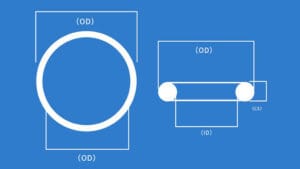
Customers often have the misunderstanding that “similar sizes can be used”, leading to excessive stretching, insufficient compression, or extrusion damage of O-rings after installation, which seriously affects service life. The core size of O-rings is “Inner Diameter (ID) + Cross Section (CS)”, which must strictly follow relevant standards and control tolerance and compression rate. The specific points are as follows:
1. Core Size Parameters: The inner diameter determines the adaptability between the O-ring and the installation hole diameter, and the cross-section determines the sealing compression and pressure resistance. The tolerance should be controlled according to the accuracy requirements of the scenario – the tolerance for general scenarios is ±0.10 mm~±0.36 mm, and for precision scenarios (such as micro-equipment and high-pressure systems), it should be controlled within ±0.05 mm. For example, for high-pressure scenarios (>30MPa), a thick cross section (above 3.55 mm) should be selected, and for low-pressure scenarios (<5 MPa), a thin cross section (below 1.8 mm) can be selected.
2. Compression Rate Control: Compression rate is the key to O-ring sealing. Too large or too small a compression rate will shorten the service life – the compression rate for static sealing is controlled at 15%~30%, and for dynamic sealing at 8%~15%. An excessively large compression rate will cause the O-ring to be in an over-extruded state for a long time, accelerating aging and permanent deformation; an excessively small compression rate cannot achieve effective sealing, and leakage and displacement are likely to occur. To answer customers’ questions of “Why do O-rings deform quickly after installation”, it is necessary to check whether the compression rate is reasonable, and at the same time,e verify the matching between the groove size and the O-ring cross-section.
3. Standard Compliance: Priority should be given to standard sizes such as national standards (GB/T 3452.1-2016), international standards (ISO 3601), and American standards (AS568A). For non-standard scenarios, detailed working condition parameters should be provided for customization to avoid installation damage caused by size deviation. For example, micro O-rings (inner diameter ≤10mm, cross section ≤1.0mm) should follow the ISO 3601-3 standard, with tolerance controlled at ±0.01mm; large-size O-rings (inner diameter ≥500mm) need to be custom-molded, and the flash width after trimming should be ≤0.1mm.
Optimize Installation Structure to Avoid Stress Damage
The rationality of the design of installation grooves and mating parts directly affects the stress state of O-rings. Unreasonable design will lead to local stress concentration, extrusion damage, and distortion of O-rings, thereby shortening their service life. To address customers’questionsn of “Why are O-rings easy to tear and curl after installation”, focus on optimizing the following three design points:
1. Groove Design: Comply with Standards to Reduce Stress Concentration
The design of groove width, dep,th and fillet must be strictly matched with the O-ring size. The core requirements are as follows: The groove depth should be calculated according to the O-ring cross section and compression rate to ensure that the O-ring fits closely with the groove after compression without gaps; The groove width should reserve expansion space for the O-ring after being heated and pressed to avoid over-extrusion; The edges and corners of the groove should be chamfered (chamfer angle 15°~30°) to remove sharp burrs and prevent scratching the O-ring surface – this is the key measure to solve customers’ problem of “neat wounds on O-rings after installation”. At the same time, for high-pressure scenarios, retaining rings (support rings) should be added on both sides of the groove to prevent O-rings from being squeezed out by high pressure and avoid edge damage.
2. Mating Part Design: Control Surface Precision to Reduce Friction Damage
The surface finish and hardness of mating pa,rts such as shafts and holes in contact with O-r, ings directly affect the wear rate of O-rings. Customers often ignore the precision of mating parts, leading to rapid surface wear and leakage of O-rings. The solutions are as follows: The surface roughness of mating parts should be controlled at Ra≤0.8μm, with no scratches, burrs or rust on the surface; For dynamic sealing scenarios (such as rotating shafts and piston rods), the mating parts should be subjected to hard chrome plating, nitriding and other treatments to improve surface hardness and reduce friction loss; Avoid sharp structures such as steps and threads on mating parts. If unavoidable, guide sleeves should be installed to prevent O-rings from being scratched when passing through.
3. Working Condition Adaptation Design: Avoid the Impact of Extreme Working Conditions
For working conditions with large pressure fluctuations and frequent temperature changes, the design should be optimized to protect O-rings: When pressure fluctuations are large, a buffer structure should be designed to reduce pressure impact and avoid O-ring damage caused by pressure shock; For scenarios with alternating high and low temperatures, heat insulation or cooling structures should be added to reduce the impact of temperature changes on O-ring materials and avoid aging and brittle fracture caused by thermal expansion and contraction. In addition, for dynamic sealing scenarios with high linear speed (>0.5m/s), lubricants compatible with O-ring materials should be applied to reduce friction and wear, which is an effective way to solve customquestionsstion of “rapid wear of O-rings in dynamic sealing”.

Standard Installation: Avoid Damage and Ensure a Good Seal
Improper installation is one of the main causes of premature O-ring damage. Many customers perform improper installation, such as rough handling, excessive stretching, or lack of lubrication, which can directly lead to scratches, deformation, or even tearing of the O-ring surface. Based on our on-site installation experience, we have summarized the following standard operating procedures to answer customers’ questions about “how to correctly install O-rings.”
1. Pre-installation inspection: Check the O-ring surface for scratches, cracks, burrs, bubbles, or other defects, and ensure that the dimensions meet design requirements. Check that the mounting groove and mating parts are clean, free of impurities, burrs, and rust. If impurities are present, wipe them clean with a clean cloth (avoid using rough cloths to prevent scratching the surface). If the O-ring has been stored for an extended period (more than 6 months), check its elasticity and aging condition; avoid using aged products.
2. Proper installation procedures: For static O-rings, gently place them into the groove, ensuring a tight fit without twisting or folding. For dynamic O-rings (e.g., piston rod seals), apply a thin layer of compatible lubricant (e.g., silicone grease, mineral oil) to the O-ring surface and the inner wall of the mounting hole to reduce friction during installation, avoid excessive stretching (stretching should not exceed 5% of the inner diameter), and prevent surface damage. When installing O-rings with larger inner diameters, use a special tool to expand them evenly; never use sharp tools to pry them, as this may cause tearing.
3. Post-installation inspection: After installation, check that the O-ring is correctly positioned and free from displacement, twisting, or extrusion. For high-pressure systems, perform a pressure test (test pressure 1.2 to 1.5 times the working pressure) to check for leaks. If a leak occurs, do not replace the O-ring directly; instead, check for correct installation, size matching, and intact grooves to prevent further damage.
Extend service life during operation
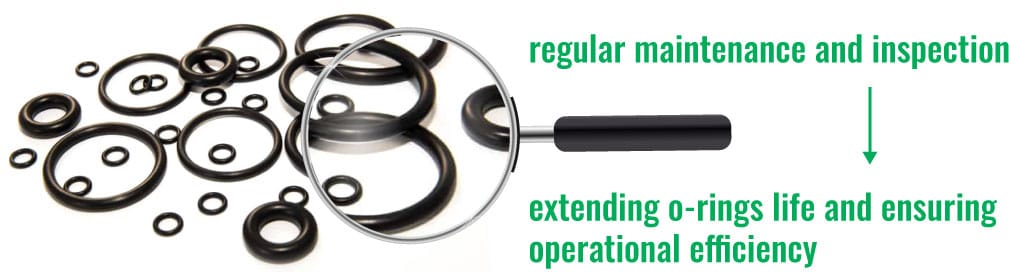
The service life of O-rings is not only related to selection and installation but also closely related to daily operation and maintenance. Many customers ignore the maintenance of O-rings during equipment operation, leading to accelerated aging and failure. The following key maintenance points are put forward to solve customers’ questions of “how to maintain O-rings to extend their service life”.
1. Control Operating Parameters: Strictly control the working pressure, temperature,e and medium purity of the system within the range adapted to the O-ring. Avoid long-term operation beyond the rated pressure and temperature, which will accelerate the aging and degradation of the O-ring material.s; Regularly filter the working medium to remove impurities and particles and prevent impurities from entering the sealing surface and causing wear of O-rings. For example, in hydraulic systems, install a filter with a filtering accuracy of ≤10 μm to reduce the wear of O-rings caused by particles.
2. Regular Inspection and Replacement: Formulate a regular inspection plan according to the equipment operation frequency. For general industrial equipment, inspect the O-ring every 3~6 months; For harsh working conditions (high temperature, high pressure, strong corrosion), shorten the inspection cycle to 1~3 months. Focus on checking whether the O-ring has aging, deformation, cracking, wear, and other phenomena. If any abnormality is found, replace it in time. It should be noted that when replacing, the same material, same size,e and same standard O-rings should be used, and mixed use of different types of O-rings should be avoided.
3. Correct Storage and Management: Unused O-rings should be stored in a clean, dry, cool and dark environment, avoiding direct sunlight, high temperature, humidity and contact with oil, chemicals and other substances that may cause aging; Store O-rings in a sealed container, avoid extrusion and deformation, and the storage temperature should be controlled at 10℃~25℃, with relative humidity ≤70%. At the same time, establish a storage management system to use O-rings in accordance with the “first-in-first-out” principle to avoid long-term storage leading to aging.
Common Failure Analysis and Solutions
In practical applications, O-rings often fail due to various reasons. Mastering common failure types and solutions can help customers quickly locate problems, reduce downtime, and reduce maintenance costs. The following are common O-ring failure types, causes,s and solutions, aiming to solve customers’ confusion about “why O-rings fail and how to deal with them”.
1. Wear Failure: The surface of the O-ring is worn, thinned, ed or has wear marks, leading to leakage. The main causes are: insufficient lubrication, poor surface precision of mating parts, and impurities in the medium. Solution: Apply a compatible lubricant, improve the surface precision of mating parts, and strengthen the filtration of the medium.
2. Aging Failure: The O-ring becomes hard, brittle, or cracked, or loses elasticity, which is mainly caused by long-term operation in high temperature, strong light, or an incompatible medium. Solution: Replace with O-rings of appropriate material, control the operating temperature, and avoid contact with incompatible media.
3. Extrusion Failure: The O-ring is squeezed out of the groove, leading to edge damage and leakage. The main causes are: excessive working pressure, insufficient groove width, and lack of retaining rings. Solution: Add retaining rings, optimize the groove design, and control the working pressure within the rated range.
4. Installation Damage: The O-ring has scratches, tears, or twists, which are caused by improper installation operations. Solution: Standardize the installation process, use special tools, and apply lubricant during installation.
Conclusion
Maximizing the service life and integrity of O-rings is a systematic project that runs through the entire process of selection, design, installation, operation, and maintenance. As professional technicians, we should guide customers to get rid of the misunderstanding of “universal selection and random installation” and focus on the core principle of “working condition adaptation”. By selecting O-ring materials and sizes accurately, optimizing the design of installation structures and mating parts, standardizing installation operations, strengthening daily operation and maintenance, and quickly handling common failures, we can effectively reduce the early failure rate of O-rings, extend their service life, ensure the long-term stable operation of equipment, and ultimately reduce the overall operation and maintenance costs for customers. It should be emphasized that there is no “one-size-fits-all” solution for extending the service life of O-rings. Only by combining specific working conditions, formulating targeted technical schemes, and strictly implementing each link of technical requirements can we maximize the service life and integrity of O-rings and give full play to their sealing performance.