Skip to content
How to correctly select O-ring size
O-ring performance depends on material, hardness, and color, but size selection is the most common challenge for buyers.
Using a systematic measurement method saves time and avoids measurement errors. Please follow the steps in this guide to ensure you order a perfectly matching O-ring.
Looking for a standard groove size to match your O-rings? Click here to view our O-ring groove design manual.
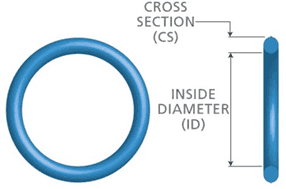
The gold standard for measuring O-rings is to determine their cross-sectional area (CS), inner diameter (ID), and thickness (H).
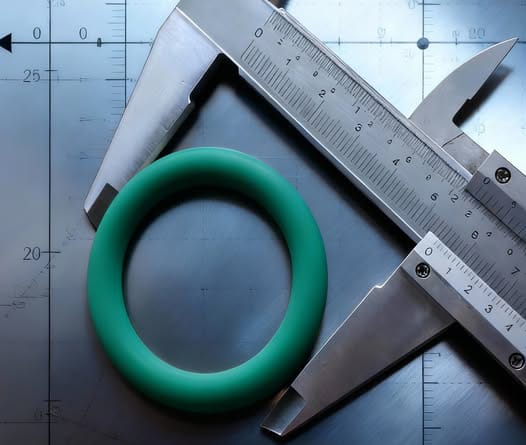
Cross-section measurement: Vernier calipers (digital or analog) are the most accurate tools. While micrometers offer the highest precision, standard vernier calipers are usually sufficient for most applications. If these tools are unavailable, a ruler can be used for a rough estimate, but accuracy may be reduced.
Inner diameter measurement: For smaller sizes, use vernier calipers. For larger O-rings, a circumferential ruler or flexible measuring tape is recommended to ensure the tape conforms to the curvature of the O-ring without distortion during measurement.
Once you have obtained the cross-section and inner diameter measurements, simply compare them to our AS568 O-ring size chart to find the closest standard size.
Metric or Imperial? O-ring Size and Tolerance Guide
All O-rings can be described in metric (millimeters) or imperial (inches) dimensions, but standardization is crucial.
If your O-rings conform to AS568, be sure to indicate the AS568 short-strike number (e.g., -001). This is the universal standard for seals in the United States. If your application requires non-standard sizes, metric O-rings may be the ideal solution.
Understanding Tolerances: Due to manufacturing limitations, actual dimensions will always deviate slightly from the theoretical ideal value. These allowable deviations are called tolerances.
Both AS568 and metric standards strictly define these acceptable ranges. For example, the nominal cross-sectional area of an AS568-100 O-ring is 0.103 inches, but the tolerance is ±0.003 inches. This means that the actual cross-sectional area of the delivered part can be legally measured anywhere between 0.100 inches and 0.106 inches and is still considered compliant with specifications.
How to identify a standard AS568 O-ring
1. Check the cross-section: If your O-rings’ cross-section dimensions are 0.050, 0.102, 0.137, 0.220, or 0.285 inches, it is likely a standard size.
2. Confirm the inner diameter: Measure the inner diameter and compare it to our size chart. Ensure the measurements are within acceptable tolerances.
Identifying Metric O-rings
The gold standard for measuring O-rings is to measure their cross-sectional area (CS), inner diameter (ID), and thickness (H).
Check the center distance (CS): If it’s not the standard AS568 inch size, it’s likely a metric size.
Measure: Precisely measure the center distance (CS), inner diameter (ID), and thickness (H) in millimeters.
Find the code: Use our metric size chart to find the size code.
Our format: KDOR0001 O-rings are in the format CS x ID x H.
Example: 7.00 (CS) x 11.00 (ID) x 2.00 (H) = 7.00 x 11.00 x 2.00
Tools for Measuring O-Rings
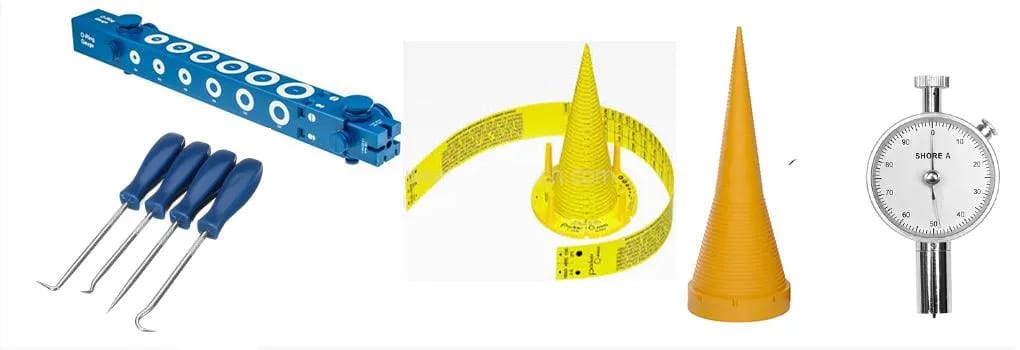
While rulers and standard tape measures are common, they rarely provide the precision required for O-ring sealing. For accurate sizing, we recommend the following professional tools:
- AS568 Size Laminated Chart: Download our easy-to-use flip chart featuring the silhouettes of 239 different O-ring sizes.
- Molded Size Cone: Place your O-ring on this cone to see if it matches one of our 184 most popular sizes.
- O-Ring Size Gauge: This sliding gauge measures O-ring inner diameters up to 13 inches.
- Caliper: A standard tool for precise measurements. While most calipers max out at 6 inches, they are excellent for measuring diameter and length on smaller parts.
- O-Sizer: A specialized measuring tape available in three sizes. It accurately measures the inner diameter of both metric and AS568 O-rings up to 26 inches.
- Pi-Tape: The gold standard for ID measurement. This precision steel tape is designed specifically for measuring the diameter of round objects with an accuracy of 0.001 inches. Available in ranges from 2″–12″ up to 48″–60″.
- O-Ring Installation Tool (PRO TOOL V): While not a measuring tool, this ergonomic tool rolls O-rings into glands quickly and safely, protecting both the seal and the groove during installation.
KODAO Ring and Seal Size Selection
KODA offers a comprehensive range of O-rings compliant with AS568 standards and covering most metric sizes.
Our industry experts are here to guide you through the sizing process. Call us today at +86 18730921709 to find the perfect sealing solution for your needs.