Skip to content
How to Choose an X-ring? A Complete Guide to Design, Performance, and Selection
Summary
In sealing system design and component selection, many customers struggle to choose X-ring seals.
They may not know where X-ring seals work best.
They may not know what design details to watch.
They may also struggle to match their equipment’s performance needs.
With the wrong choice, seals may leak, wear too fast, or fail early.
These issues can disrupt normal equipment operation.
They can also increase maintenance costs and downtime losses.
This comprehensive X-ring sealing ring selection guide addresses four core dimensions: design compatibility, performance parameters, selection process, and common misconceptions. It aims to help you fix the pain of choosing the wrong option and using it poorly. It helps you match equipment needs accurately, improve sealing reliability, and lower overall operating costs.
What is X-Ring?

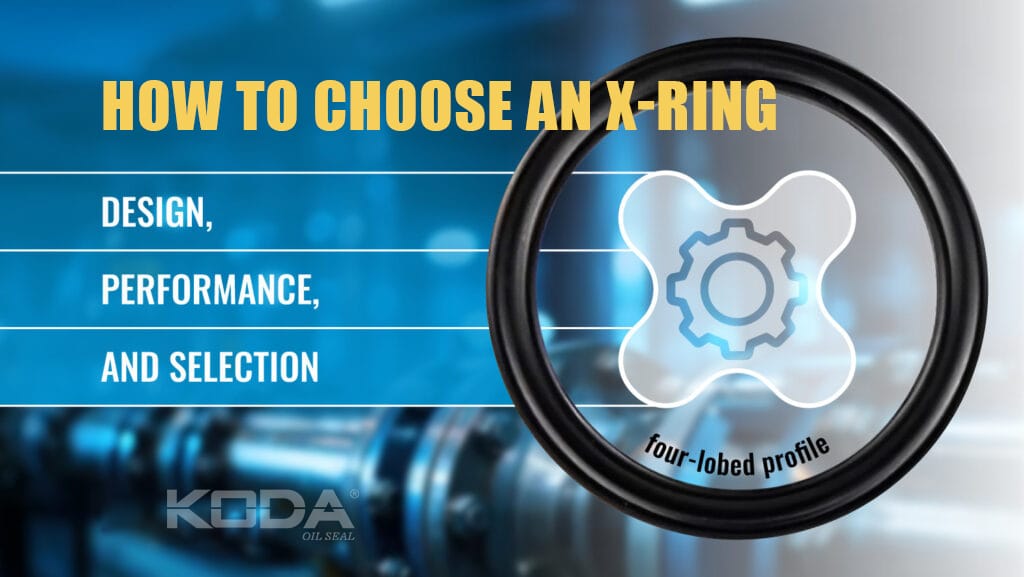
X-Ring (also known as X-ring, star ring, or Quad Ring) is a four-lip elastic seal with an X-shaped cross-section. As a high-performance upgrade of O-rings, it combines static and dynamic sealing. Its core advantages are low friction, torsion resistance, long service life, and dual sealing.
- Cross-sectional shape: Four symmetrical X-shaped lips form a lubricating cavity between the lips. It stores a small amount of medium or grease. This provides continuous lubrication for the sealing lips.
- Sealing mechanism: After installation and compression, double independent sealing lines are formed. The higher the pressure, the stronger the lip adhesion. This creates a self-tightening seal. It also provides more stable bidirectional pressure resistance.
- Installation compatibility: Can directly replace O-rings of the same specification without modifying the groove, offering strong adaptability.
The core advantages of X-ring
The first step in choosing an X-ring sealing ring is to confirm it fits your equipment. Do not follow trends blindly. Compared to O-rings and Y-rings, X-ring sealing rings have clear benefits.
They are also called four-lip sealing rings.
These benefits make them well-suited for certain applications. Understanding these advantages will help you make a quick decision:
- Low frictional resistance, suitable for high-speed scenarios: The X-ring seal has an “X”-shaped cross-section. This creates a small contact area with the sealing surface. Friction during startup and operation is much lower than with O-rings. This makes it suitable for high-pressure, high-speed reciprocating or rotary equipment. Examples include hydraulic cylinders, pneumatic cylinders, and gearboxes. This prevents seal wear and increased energy consumption due to excessive friction.
- Strong resistance to extrusion, less prone to damage: The four-lip structure of the X-type seal provides better self-support. Under high pressure, it is less likely to squeeze into the sealing gap (“extrusion damage”). This removes the need for extra retaining rings. It also lowers accessory costs and simplifies installation. It is especially suitable for scenarios with large gaps and frequent pressure fluctuations.
- High sealing reliability, adaptable to multiple media: The four-lip structure provides a double sealing effect. Even if one lip experiences slight wear, the remaining lips maintain sealing performance, reducing the risk of leakage. It works with many media (oil, water, gas, and more). This makes it versatile and helps customers replace seals less often.
Additional reminder: If your equipment runs at low speed and low pressure, with very small sealing gaps, use O-rings. They cost less and are easier to install. So, you do not need to choose X-rings. X-rings are a better choice only when you need high speed and high pressure.
They also work well when you need extrusion resistance and low friction.
This helps you avoid wasting money by choosing the expensive, wrong option.
Design adaptation key points: Avoid improper design leading to selection failure
Many customers have reported that “even after choosing the right X-type sealing ring, leaks and damage are still common.” The core reason is an unreasonable sealing groove design, not a quality issue with the sealing ring itself. The following three design points must be strictly followed by customers during equipment design or sealing groove fabrication. They are simple to implement and can be mastered without professional design experience:
1. Sealing groove size design
The dimensions of the sealing groove, including width, depth, and fillet radius, set the X-ring fit. They also control the sealing effect. Even a 0.1mm deviation in dimensions can cause problems. It is recommended to design according to the following standards (compatible with most conventional X-rings):
- Groove width: 0.1~0.3mm, larger than the X-ring cross-sectional width. Adjust based on ring size. This allows enough compression and expansion space. This prevents excessive tightness, leading to ring deformation or excessive looseness, leading to excessive sealing gaps and leakage.
- Groove depth: The key is controlling the “compression ratio” of the ring. Under normal operating conditions, keep the compression ratio between 10% and 20%. For example, for a 3 mm X-ring, the compressed height should be 2.4 to 2.7 mm. Under high-pressure conditions (pressure > 10MPa), it can be appropriately increased to 15%~25% to enhance extrusion resistance. Under low-pressure conditions (pressure < 5MPa), it can be controlled at 8%~15% to reduce frictional resistance.
Rounded corners: Round the inner and outer corners of the sealing groove to R0.2–0.5 mm.
This prevents sharp edges from scratching the sealing ring lip.
- Scratches can cause leakage. This is a detail that many customers easily overlook, and it is also a frequent cause of seal failure.
2. Sealing gap control
The sealing gap (the maximum space between sealing surfaces) is vital for the X-ring seal’s extrusion resistance. If the gap is too large, the seal can easily be squeezed into the gap and damaged under high pressure. It is recommended to control the gap according to the following standards:
- Low-pressure conditions (pressure < 5MPa): Sealing gap ≤ 0.15mm;
- Medium-pressure conditions (5~15MPa): Sealing gap ≤ 0.10mm;
- High-pressure conditions (>15MPa): Sealing gap ≤ 0.08mm. If the gap cannot be reduced, add a retaining ring. A metal or plastic retaining ring is acceptable. This helps prevent extrusion.
3. Installation and movement surface requirements
- Installation Requirements: During installation, clean the sealing groove and sealing surface. This prevents impurities, like iron filings and dust, from sticking. These impurities can scratch the sealing ring lip. If the sealing ring is large, apply a small amount of media-compatible lubricant to the mounting surface. Use a lubricant such as hydraulic oil. This helps with installation and prevents hard pulling that could deform or tear the sealing ring.
- Moving Surface Requirements: Control the surface roughness of moving parts in contact with the X-type sealing ring. Moving parts include pistons and piston rods. Keep roughness at Ra ≤ 0.8 μm. This prevents scratches on the seal lip. The moving surfaces must also be free of burrs and scratches, ensuring a smooth and flat surface.
4. Resisting spiral failure
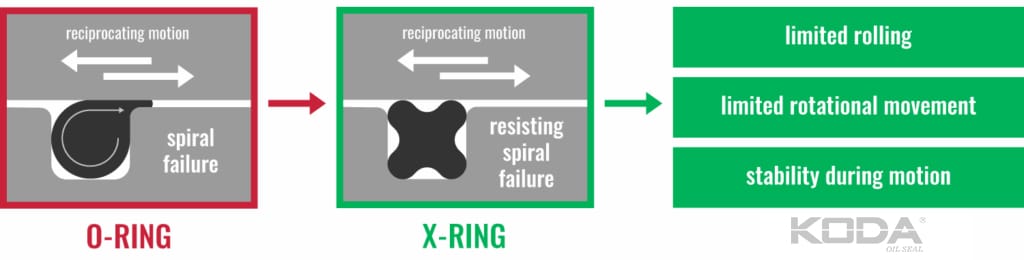
Spiral failure is a common failure mode of reciprocating dynamic seals, referring to the twisting and curling of the seal along the circumferential direction during reciprocating motion, eventually leading to tearing, extrusion, or seal failure. This phenomenon is mainly caused by rolling and torsional stresses and uneven friction generated during the seal’s movement.
X-rings (X-rings/star-shaped rings) possess excellent resistance to spiral failure. Their four-sided cross-section limits rolling and twisting of the seal in the groove. This greatly improves sealing stability during reciprocating motion. This reduces mechanical factors that induce spiral twisting and early failure, extending the seal’s service life.
X-Ring performance parameters matching
Common customer selection mistakes
The performance of X-rings is primarily determined by their material, cross-sectional dimensions, and hardness. When selecting a model, customers do not need to focus on complex technical parameters. They only need to match the right performance parameters to their equipment’s operating conditions. Different operating conditions need different sealing ring performance. Precise matching is essential to extend service life and prevent leakage.
1. Material Selection
The material determines the X-ring’s resistance to media and temperature. Choosing the right material can prevent the seal from being corroded by the media or aged by high temperatures. This is the part where customers are most likely to make mistakes. Below are common materials and their suitable scenarios. You can directly refer to the comparison to select the appropriate material:
- Nitrile butadiene rubber (NBR): The most versatile and cost-effective material, suitable for mineral oil, hydraulic oil, and water. Temperature range: -30℃ to 120℃. Suitable for conventional industrial equipment (such as ordinary hydraulic cylinders and machine tools). If your equipment operates under normal conditions, this is the preferred choice due to its low cost and versatility.
- Fluororubber (FKM): High temperature and corrosion resistant, suitable for high-temperature oils, acid and alkali media, and organic solvents. Temperature range: -20℃ to 200℃ (some special models can reach 250℃). Suitable for high-temperature and corrosive conditions (such as engines, chemical equipment, and high-temperature gearboxes). The disadvantage is a slightly higher cost; not necessary for conventional applications.
- Silicone rubber (MVQ): High and low temperature resistant, non-toxic, suitable for water, air, and food-grade media. Temperature range: -60℃ to 200℃. Suitable for low-temperature, food, and medical industries (such as refrigeration equipment, food machinery, and medical instruments). The disadvantage is poor extrusion resistance, making it unsuitable for high-pressure conditions.
- Hydrogenated nitrile butadiene rubber (HNBR): Oil-resistant, aging-resistant, and tear-resistant, suitable for high-pressure and high-temperature oil media, with a temperature range of -40℃ to 150℃. It is suitable for high-pressure hydraulic systems and engineering machinery (such as hydraulic cylinders of excavators and cranes). Its comprehensive performance is superior to nitrile butadiene rubber, making it suitable for scenarios with high requirements for sealing reliability.
2. Selection of cross-sectional dimensions
The cross-section size of X-type sealing rings must match the sealing groove size exactly. Common diameters are 1.5 mm, 2.0 mm, 2.4 mm, 3.0 mm, and 5.0 mm. The core principle is that the cross-sectional diameter and sealing groove depth should match. This helps ensure a compression ratio between 10% and 20%.
Additionally, if you are unsure which cross-sectional size to choose, give the sealing ring maker the groove width and depth. The manufacturer will directly match the corresponding cross-sectional dimensions, avoiding calculation errors, saving you time, and reducing the difficulty of selection.
3. Hardness Selection
The hardness of X-rings is expressed in Shore A hardness (HS). Common hardnesses are 70HS and 80HS, with 60HS and 90HS used in a few applications. Selection is based on equipment pressure and speed of movement:
- 70HS (softer): Low friction, suitable for high-speed movement and low-pressure conditions. Examples include high-speed cylinders and low-pressure hydraulic systems. It provides a good sealing fit and minimal wear during operation.
- 80HS (harder): Strong compression resistance and good wear resistance. It works well in high-pressure, low-speed movement conditions. Examples include high-pressure hydraulic cylinders and heavy equipment. It helps prevent deformation and compression under high pressure.e
- Special applications: 60HS is softer and helps prevent hardening and cracking in low temperatures.
It is suitable for low-temperature applications.
90HS is harder and improves wear resistance.
It is suitable for high-pressure, high-wear applications.
Common customer selection mistakes
Based on years of customer service experience, we have compiled four common selection mistakes. Many customers overlook these issues, leading to premature failure and leakage of the seals. Reading this guide will help you avoid these pitfalls, reducing maintenance costs and downtime losses:
Myth 1: People focus only on size and ignore the material.
For example, using nitrile rubber (NBR) seals in hot, corrosive fluids can wear out quickly.
This can lead to leaks.
The correct approach is to choose the material first, then the size.
Myth 2: Pursuing “the higher the hardness, the better” – Too much hardness increases friction. This can cause early wear on the sealing lip. It is worse at high speeds and shortens service life. The hardness should be adjusted appropriately based on pressure and speed.
Myth 3: Arbitrarily designing sealing grooves – For example, a groove that is too shallow may cause low seal compression. This can lead to leaks. A groove that is too deep may cause over-compression. This can increase friction and deform the seal. The design of sealing grooves must strictly adhere to standards.
Myth 4: Not removing dirt during installation and pulling out the seal by force. Dirt can scratch the lip, and force can tear it. Before installation, the seal must be thoroughly cleaned, lubricated if necessary, and installed smoothly.
Q&A: X-Ring Design, Performance, and Selection
What is the structural design of the X-Ring?
The X-Ring has a symmetrical, four-lip, X-shaped cross-section. It has four sealing lips and a central oil reservoir. This differs from an O-ring, which has a circular cross-section. The symmetric lips ensure even stress distribution. The built-in oil reservoir and self-positioning structure make installation and movement more stable.
What are the design advantages of X-Ring compared to O-ring?
The four lips form a double sealing line, resulting in stronger low-pressure sealing.
The central groove can retain oil, reducing friction and temperature rise. The cross-section is torsionally resistant, making it less prone to flipping or twisting during movement. The smaller contact area results in lower friction at the same compression ratio.
Why is the X-Ring’s sealing performance more reliable?
It relies on redundant sealing with four lips and double sealing lines. Even if one lip is slightly damaged, the other lip can still seal. The higher the pressure, the stronger the lip adhesion. This leads to a lower leakage rate under high pressure. It also helps during dynamic operating conditions.
Can an X-Ring directly replace an O-ring?
Most of the same specifications (AS568, etc.) can be directly replaced without modifying the groove; however, for dynamic seals, high-pressure, and high-speed applications, it is recommended to check the groove fill rate and guide angle to ensure that the lip does not fold over.
When should X-rings be prioritized over O-rings?
- Reciprocating/rotary dynamic seals require low friction and a long lifespan.
- High-pressure, high-speed, and torsional applications.
- Low-pressure applications require reliable sealing and low starting resistance.
- Clean/low-oil applications relying on self-lubrication.
- Hydraulic/pneumatic/precision transmission systems with strict requirements for temperature rise, wear, and lifespan.