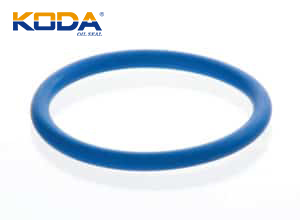
Fluorosilicone O-Rings
Fluorosilicone rubber (FVMQ) O-ring material specifications

Fluorosilicone rubber (FVMQ) has side chains containing trifluoropropyl, methyl, and vinyl groups, and its mechanical and physical properties are similar to those of silicone rubber (VMQ). It is more resistant to fuels and mineral oils than ordinary VMQ, but its resistance to hot air is slightly weaker. Fluorosilicone rubber is actually a composite material of fluororubber (FKM) and silicone. Because it does not easily deform after compression and performs stably in high and low temperature environments, fluorosilicone rubber O-rings are now increasingly used. However, it is most commonly used in the aerospace field, primarily due to its resistance to aviation fuel corrosion; additionally, its wear resistance is relatively low, making it more suitable for static sealing applications.
Fluorosilicone rubber (FVMQ) O-rings are typically blue and can be stored for extended periods. KODA’s standard FVMQ O-rings meet FDA standards, and customized products that meet UL-157 standards are also available.
Peroxide curing system
Standard FVMQ compounds are cured using metal peroxides.
Temperature range of fluorosilicone rubber O-rings:
Standard low temperature: -60°C (-76°F)
Standard high temperature: 177°C (350°F)
Specifications: FDA-compliant fluorosilicone rubber (FVMQ) with a hardness of 70.
Specifications: UL-157-compliant fluorosilicone rubber (FVMQ) with a hardness of 70.
Preferred Environmental Guidelines for Fluorosilicone Rubber O-rings
Performs Well In:
- Fuels
- Aromatic mineral oils
- Benzene, toluene
- Ozone and weather
Doesn't Perform Well In:
- Brake fluid
- Ketones
- Hydrazine